
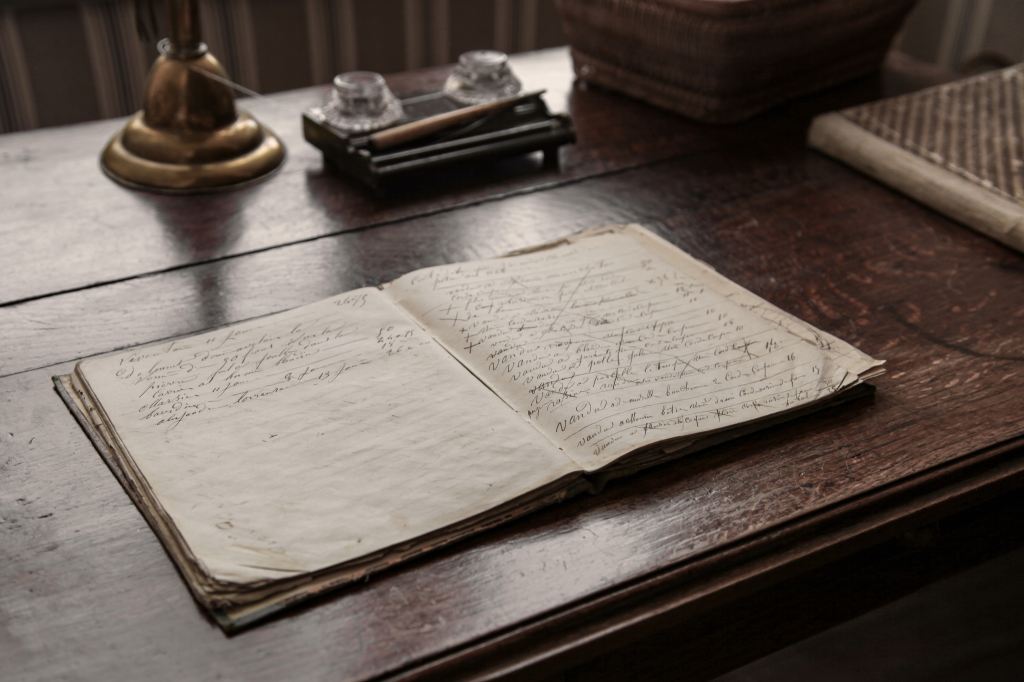
It comes to me sometimes, that I lose the pattern of speaking in my writing. It’s when the Trying-too-hard becomes a battle with the Want-to-be. Want-to-be believes itself superior to Trying-too-hard; whereas Trying-too-hard is distinctly jealous of Want-to-be. The battle worsens when Unpretentious Language tries to intervene.
The unpretentious language is my grandparents. That’s my Dad’s parents. They are the ones I grew up knowing. Their language was the Hampshire dialect of words ending in ‘t’ that did not spell that way.
‘He went acrost the field.’
A mixture of across and crossed. The Old English whilst, whenst and all other words fading in the language of the modern world. I love that old world language. When horses becomes ‘orses. When chickens are just chicken, without the plural ‘s’.
When I speak like my grandparents, I find a flow of language I love hearing. It speaks in a way that clarifies my thinking, that doesn’t judge the incorrectness that it would be on the written page. It doesn’t glamorize words or inspects them closely. It just feels the words that are to be said; and when they are said, they feel right.
A voice that sang what it felt, and waited for thought afterwards, to find that the thought had been there already in the feeling.
Ellis Peters, A Morbid Taste for Bones
The very essence of my writing comes from that which I know and love best, including language. But it can still be hard to strike that balance between an honest voice and language and making sure that it’s understandable.
Learning From Shakespeare
Shakespeare is one of my guidelines for writing. Somehow, in the lyrical speech of his day, he was able to use both the honesty of his voice and the written word to some distinction. There have been many working-class people who have become writers since. Shakespeare’s distinction was that he was the first.
Considered an inventor of words, his work is applauded as the epitome of writing by many scholars. And yet, the reason for his popularity was because he wrote as the people, for the people.
His inclusion of words attributed to his creativity are simply those spoken by the general populace being shared to the masses. He created an œuvre that has come to be revered as genius, and yet all he did was what his contemporaries would never have considered — the common language.
I’ve read the theories about how a working-class man could not have written all that Shakespeare did. It had to be someone of a much higher rank with a superior education. How insulting! And yet, perhaps complimentary.
The illusion of this theory lies in the lack of understanding of everyday people. In these are the natural philosophers, the observers of life, with a flow of language that can surpass the stilted nature of formal education. The majority of the people may have been denied that education, but the eloquence of speech is there for everyone; and it seems that Shakespeare is one of those naturally talented individuals who managed to find an outlet for his gift of words.
It may seem to such theorists that a common man being a writer, and a famous one, is ludicrous. After all, he would be a square peg trying to fit into a round hole. As such, he would never be able to become a writer.
But I don’t think that Shakespeare tried to fit the hole that others had made. I think he made the shape that suited him. After all, how better for a man to stand out, than to create his own niche. And it made him more famous than his well-educated, aristocratic contemporaries.
He knew the voice of a people that could speak with their souls, and he used that, not to write with the stilted tone of education, but with the flow of everyday life. And it was this that made him truly stand out.
Shakespeare’s Language
Linguistic experts have noted how Shakespeare’s poetic works do not always work with modern pronunciation. Working with a more vernacular speech pattern seems to indicate a different type of voice than ours, as the following video explains.
This obviously does not prove that he was working-class, but his voice was not the received pronunciation of actors, nor like our own speech patterns. It’s interesting to note, too, how the change to a more English country sounding accent seemed to make a difference to the delivery of the words.
Other experts have noted certain words in his works that were more commonly, or singularly, used in Warwickshire, Shakespeare’s land. In the BBC documentary In Search of Shakespeare, Michael Wood reveals words that Shakespeare used in his plays, that are inherently from the Warwickshire dialect.
So, Shakespeare proved that the common language could be something beautiful and could be used to great effect.
Now, if only I could do it as well as he.
Copyright © 2023 Charlotte Clark
 Charlotte Clark